O'Malley decries immigrant health care cut - Articles of Faith - Boston.com
Posted using ShareThis
Cardinal Sean P. O'Malley, the Roman Catholic archbishop of Boston, is expressing opposition to a possible cut to state-subsidized health insurance coverage for some legal immigrants.
Here's the relevant portion of his most recent blog entry:
"As I do upon occasion, before I get to the events of my week, I would like to comment on an issue that is of great importance to me.
The Governor and the Legislature in the commonwealth face excruciatingly difficult choices this week. Final decisions about the budget bring together the fact of an economy in deep recession, declining state revenues and multiple human needs among the citizens of the commonwealth. Those human needs for nutrition, housing and health care must be a high priority for the Church and its ministry.
Our agencies Catholic Charities, the Caritas Health Care System and the Office of Planning and Urban Affairs are stretched to the limit these days, but that is the work we should be doing.
A particular issue of concern to me is the possibility that funding for health coverage for 28,000 legal immigrants may be cut in whole or in part. The Church, through Catholic Charities and through our parishes, is in direct and regular service of the immigrant community.
My hope and my request is that a way can be found to sustain health coverage for these legal members of our community. Their resources are few and their support system is always stretched thin. The commonwealth has done a very commendable job of providing health care to the citizens of Massachusetts. It would be a tragic mistake to let these 28,000 members of our community lose access to the precious good of health care."
(Photo, by John Blanding of the Globe staff, shows Cardinal Sean P. O'Malley of Boston in Gloucester on June 28, 2009.)
Tuesday, July 28, 2009
O'Malley decries immigrant health care cut - Articles of Faith - Boston.com

Monday, July 27, 2009
MA Treasurer Statement Justifies Treatment of Immigrants
Treasurer Devalues Immigrants
BOSTON-- On Friday, State Treasurer Tim Cahill raised the ugly rhetorical justification for the state legislature's termination of healthcare coverage to 30,000 legal, tax-paying residents. Commenting on the legislature's decision to cut recent permanent residents and other immigrants from Commonwealth Care coverage, Cahill told the State House News Service that immigrants may be receiving the message, "Come to Massachusetts and we'll cover you." The subscription-only service went on to quote Cahill, "That's not really protecting our own citizens who have grown up here and spent their lives here and want to either raise a family or keep their family here, like I'm trying to do."
"This is an extremely offensive statement," said Eva Millona, Executive Director for the Massachusetts Immigrant and Refugee Advocacy Coalition (MIRA). "It is contrary to the spirit of inclusion that the Commonwealth stands for. Such a high-ranking state official should know that Massachusetts is one of four states with an official Integration Agenda, which acknowledges immigrants' valuable contribution to our community and economy. As treasurer, in particular, he should treasure what immigrants offer."
Proof is presented by the recently released report "Massachusetts Immigrants by the Numbers: Demographic Characteristics and Economic Footprint," prepared for the Immigrant Learning Center in Malden by Alan-Clayton Matthews, Faye Karp, and Paul Watanabe. The report shows conclusively that the state's immigrant population "countervails the net out-migration from Massachusetts to other states" and offsets the aging of our native-born workforce. Indeed, immigrants represent a larger percentage of the workforce (17 percent) than they do of the general state population (14 percent). The report also shows that "immigrants pay into the state income tax system at a higher rate than their percentage of the population."
"Cahill should know that immigrants don't come here to claim benefits," Millona continued. "They come here to work and raise their children in one of the most inclusive states in the most inclusive nation in the world. Cahill may be raising his family here, but you have to wonder if he shares our Commonwealth's values."
Wednesday, July 15, 2009
Immigrant fighting cancer and the fear of losing care - The Boston Globe
Immigrant fighting cancer and the fear of losing care - The Boston Globe
Posted using ShareThis
By Kay Lazar and Maria Sacchetti, Globe Staff | July 15, 2009
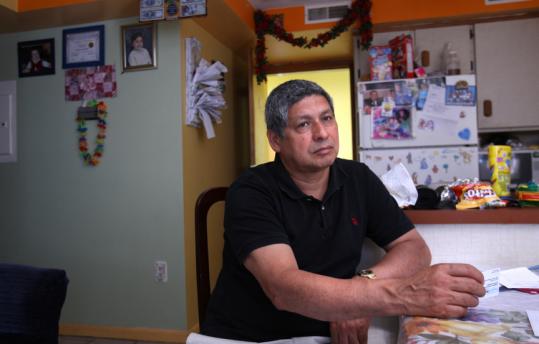
Eugenio Hernandez believes that coming to America saved his life.
Almost two years ago, the immigrant from El Salvador was diagnosed with cancer, and his doctors in Boston fought it with surgery, radiation, and multiple checkups. It still lurks inside his stocky frame, but he is alive, and he has insurance.
Now he is among 30,000 legal immigrants who are poised to lose their state-subsidized health insurance at the end of the month, as Massachusetts leaders wrestle over the state budget.
As a low-wage worker with an expensive disease, he is suddenly confronting an unexpected dilemma: He cannot afford insurance, but missing his checkups could put him at risk.
“For me, the illness doesn’t end,’’ he said yesterday, sitting in the tiny parlor of the apartment he shares above a red-brick bodega in East Boston. “I have to keep going. I can’t just lie down and die.’’
State lawmakers deleted money for immigrants’ health insurance as one of many cuts made to balance the budget for the fiscal year that began July 1.
Governor Deval Patrick has proposed a $70 million compromise plan that would grant immigrants access to medical care in August, when their coverage ends, through a patchwork of other state programs that health advocates say is spotty and confusing, especially for those who, like Hernandez, do not speak English.
The proposal would require lawmakers and state regulators to create an alternative insurance system for these immigrants come September. Lawmakers expect to vote on the proposal before the end of this month.
If lawmakers reject the proposal, legal immigrants would use a state program, Health Safety Net, that would allow a limited amount of medical care indefinitely, but they would pay a larger share of their care than they do now.
The uncertainty is creating an anxiety that is palpable, said Carlos Solis, a counselor at the consumer group Health Care for All, who is helping Hernandez and dozens of other immigrants navigate the state system. The group has received calls from more than 200 families.
“The question we keep receiving is, ‘What am I going to do?’ ’’ Solis said.
Lawmakers proposed eliminating healthcare for legal immigrants because, as noncitizens, they do not qualify for matching federal subsidies and thus are more expensive for the state to insure.
But health policy specialists say terminating the immigrants’ coverage is probably going to shift costs to other portions of the state budget, as well as to hospitals that care for them.
“At least a portion of the costs . . . are still going to occur, because people will still get care if they need it. The question is, who is going to be paying for it?’’ said Anya Rader Wallack, executive director of the Massachusetts Medicaid Policy Institute and cochairwoman of a state-created committee that will soon recommend proposals to contain soaring healthcare costs.
The 30,000 immigrants caught in the middle have “special status’’ in the immigration system. Many have been in the country less than five years and are seeking asylum from war-ravaged regions.
Hernandez, a 51-year-old janitor, said he arrived in the United States on a visa in 1993, a year after a 12-year civil war ended in his homeland. He applied for asylum and was denied, but was able to obtain temporary legal status in 2001 after a series of earthquakes shattered his country.
Before his illness, his priority was work: He had two jobs, cleaning office buildings during the day and at night. Health insurance seemed beyond his reach.
Besides, his older brothers and a sister in El Salvador needed the money he sent home.
Then one day in 2007, he felt pain while going to the bathroom.
A local doctor referred him to Tufts Medical Center, where a specialist diagnosed him with prostate cancer. The rest is a blur: He recalls the worry on the doctors’ faces and being told that he had a 50 percent chance of survival. The doctors rushed him into surgery in October 2007.
“I didn’t know anything,’’ he said, shaking his head. “I fell into a depression. I didn’t ask anything.’’
After the surgery he spent two nights in the Boston hospital, and then embarked on a series of critical checkups. At three months and at six months, he was fine.
At nine months, the cancer was back. Eight weeks of radiation followed.
“The doctors have done everything for me,’’ Hernandez said. “Without them, I would have died.’’
But his illness has devastated his finances: Shortly after the operation, he received a bill for $24,000 because he did not have insurance at the time. The debt, which he is fighting through a lawyer, is more than he earns in a year.
“See how it is when you don’t have insurance?’’ he said, gesturing to the bill.
The cancer also cost him his day job. When he told the boss he needed two months to recover from the surgery, he was fired.
Now he works part time at night, sweeping and vacuuming an office building after the employees have gone home. He usually grosses $350 a week.
His latest pay stub shows that he has made a total so far this year of about $13,400, including overtime, and has paid roughly $2,000 of that in federal and state income taxes.
To keep costs low, he does not own a car, never eats out, and rents a room for $250 a month in a third-floor flat in East Boston, up a staircase covered with a tattered gray carpet.
Losing the insurance while still being treated for cancer is unthinkable, he said. He has no savings and has two doctor’s appointments coming up.
At the last visit, he underwent scans, because his doctor worried that his cancer may have spread.
“I don’t know what’s waiting for me,’’ he added. “Now, I’m OK. But what if I need more surgery, more radiation? And what if I don’t have insurance?’’
Maria Sacchetti can be reached at MSacchetti@globe.com. Kay Lazar can be reached at klazar@globe.com
Thursday, June 11, 2009
The Least of These
Click below to watch The Least of These.
The Least of These explores one of the most controversial aspects of American immigration policy: family detention.
As part of the Bush administration policy to end what they termed the “catch and release’” of undocumented immigrants, the U.S. government opened the T. Don Hutto Residential Center in May 2006 as a prototype family detention facility. The facility is a former medium-security prison in central Texas operated by CCA, the largest private prison operator in the country. The facility houses immigrant children and their parents from all over the world who are awaiting asylum hearings or deportation proceedings.
The facility was initially activated with little media attention or public knowledge. Soon, however, immigration attorney Barbara Hines was contacted by detainees seeking representation, and she became increasingly concerned about the troubling conditions there. She joined forces with Vanita Gupta of the ACLU and Michelle Brané of the Women’s Refugee Commission to investigate conditions and seek changes. Their efforts were initially hampered by a lack of openness and oversight within the Immigration & Customs Enforcement (ICE) organization. Undeterred, the three attorneys attempted to bring about changes in both policy and conditions, by making their findings public, encouraging involvement by activists and the media, and ultimately by filing a historic lawsuit.
As these events unfold, the film explores the government rationale for family detention, conditions at the facility, collateral damage, and the role (and limits) of community activism in bringing change. The film leads viewers to consider how core American rights and values – due process, presumption of innocence, upholding the family structure as the basic unit of civil society, and America as a refuge of last resort – should apply to immigrants, particularly children.
Tuesday, June 9, 2009
Berkshire Immigrant Center Presents Meeting on Comprehensive Immigration Reform
The Berkshire Immigrant Center will sponsor a community meeting on the current status of immigration legislation and Comprehensive Immigration Reform. The event will take place on June 18th from 12:00 pm to 2:00 pm at the First Baptist Church, 88 South Street, Pittsfield, MA. The event is free, and immigrants’, advocates, and the general public are invited to attend.
President Obama has made it clear that he is committed to enacting comprehensive immigration legislation during the early stages of his presidency. The meeting will present facts about the current immigration landscape, offer legislative updates, and focus on proposed facets of immigration reform including increasing the number of available humanitarian and non-immigrant visas, family reunification, Border Security and enforcement policies, the Dream Act, AgJobs, and a legalization program that will provide a pathway to citizenship for millions of undocumented immigrants.
The meeting will be presented by Marcony Almeida, Director of Organizing, at the Massachusetts Immigrant and Refugee Advocacy Coalition (MIRA). This is a great opportunity for immigrants, immigrant advocates, and interested community members to gather, learn, and address ways to work together to help fight for practical solutions that benefit us all and are rooted in the restoration of the rule of law, earned citizenship, united families, and fair treatment of workers.
“There is no doubt that our current immigration system is not working for American citizens, permanent residents, and the undocumented and their families. We need Comprehensive Immigration Reform that is just and fair and addresses all sides of the issue – economics, enforcement, security, but above all family reunification and humanity,” stated Hilary Greene Director of the Berkshire Immigrant Center. “We invite the public to learn about proposed legislation, dispel myths, and rally their support.”
The Berkshire Immigrant Center assists individuals and families in making the economic, psychological and cultural adjustment to a new land, not only by meeting basic needs, but also by helping them to become active participants in this society. The Center provides citizenship assistance, immigration information, advocacy, referrals and counseling to the growing immigrant communities in Berkshire County.
For more information please contact the Berkshire Immigrant Center at (413) 445-4881 or info@berkshireic.com.

